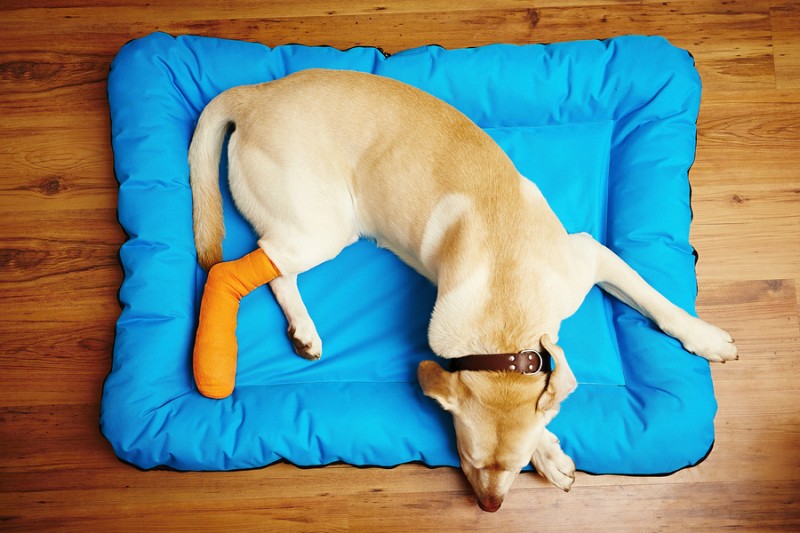
A hit or fall are the main causes of broken bones in dogs. Also the age or physical condition of the dog will affect to a greater or lesser extent the severity of the situation. Since one day we could see ourselves in this situation, we will know how we should act before a fracture in a dog.
A fracture is a partial or total break of a bone. Depending on the severity and type of fracture, it may or may not be visible. Thus, some can break the skin and appear to the outside, while at other times the displacement of the bone remains inside the skin.
Knowing how to act on a fracture is vital, because although they have treatment, if we do not act quickly we can endanger the life of the animal. Some factors that will influence the trigger or evolution are the age of the dog, weight, lifestyle or possible pathologies that may suffer.
As we say, sometimes an accident does not have to have a greater impact than the localized damage itself. But so that gravity does not transcend, it is necessary to know how to act before a fracture in a dog.
If you have been lucky enough not to see yourself in this situation but you want to learn not to take risks, or if it has happened to you and you have not known how to react, we will know the steps we must take to help an injured animal.
Whether we have knowledge of first aid or not, we should call a veterinarian as soon as possible. If we have a vehicle, it is important to move it as soon as possible. In the event that we do not have one, we can consult directly with our veterinarian.
Some veterinary clinics have an ambulance service available for the collection of injured animals. We must remember that as with non-visible fractures, there may be other traumatisms that we do not perceive. Knowing how to act in the face of a fracture or an accident is essential to save their lives.
If it is a visible fracture and we have knowledge of first aid, we can proceed to immobilize the area. A newspaper or a magazine can be useful to us. It is enough to tie them or hold them with a bandage around the fractured limb.
However, before rushing to act on a fracture, we must ask ourselves if we really know how to do it. If we are not in possession of minimal knowledge about the splinting of a limb, it is better to wait for assistance. In addition to worsening the situation if there are joints involved, we can cause pain to the animal.
Sometimes the animal can become unconscious, and acting on a fracture in these cases becomes more important. When moving it, we must raise its head and avoid compressing or bending its neck. Major risks that may occur are choking when swallowing the tongue or cervical damage.
Our veterinarian will then take care of immobilizing the area correctly or performing surgery if necessary. For its recovery, it will be necessary to use splints or other accessories that protect the area.
Canine orthopedic surgery is an increasingly common procedure in dogs with joint problems or trauma,…
Hydrotherapy for dogs has established itself as one of the most effective techniques within canine…
Mobility is one of the fundamental pillars of the quality of life of dogs. An…
Physiotherapy for dogs is a fundamental tool to improve the quality of life of those…
Over the years, our dogs age, and with old age come physical and mental changes…
Anti-inflammatory drugs, called NSAIDs (nonsteroidal anti-inflammatory drugs), are the most commonly prescribed pain reliever in…