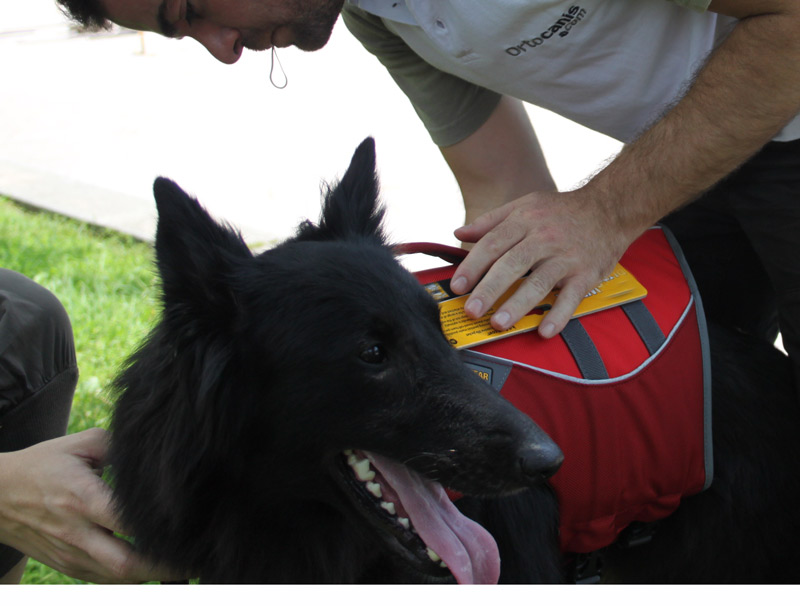
On summer days, their wet tongue cools them down as much as it does our sweaty armpits . But luckily for the dogs, their tongues don’t actually sweat.
Animals with little hair on their bodies – such as humans, horses and some species of monkeys – cool down when sweat evaporates from their skin. For species with long hair, such as dogs, sweating would be like putting on a sodden coat. For this reason, dogs stick out their tongues and pant to cool down .
It takes energy, in the form of body heat, to evaporate fluid from the surface of the skin or tongue, explains Jack Boulant, a thermal physiologist at The Ohio State University , when heat evaporates moisture from the surface, the low body temperature .
After a few years, scientists have discovered that dogs’ internal thermostat, the thermoregulatory system, reacts to heat by pumping warm blood to the tongue, opening the salivary glands, and causing rapid, shallow breathing . As the warm air flows down the windpipe and tongue, it helps to evaporate moisture, which removes heat from the dog’s blood.
In addition to lowering body temperature, this process helps cool the brain . The blood circulates through the nose and tongue and reaches the brain cooler, which keeps the organ that regulates heat at a lower temperature than the rest of the body. The cooling system also works for short-nosed breeds, such as the Pekingese, which has a smaller muzzle and narrower air passages.
Any other refrigeration system in the animal world?
In fact, dogs aren’t the only animals that use clever tricks to cool off. The rats lick their bellies. Kangaroos, when resting, blow and lick their bodies, and jumping makes them stop sweating. And this may not sound very good, but storks relieve the heat by defecating on their long legs.
Source:Quo.es
Canine orthopedic surgery is an increasingly common procedure in dogs with joint problems or trauma,…
Hydrotherapy for dogs has established itself as one of the most effective techniques within canine…
Mobility is one of the fundamental pillars of the quality of life of dogs. An…
Physiotherapy for dogs is a fundamental tool to improve the quality of life of those…
Over the years, our dogs age, and with old age come physical and mental changes…
Anti-inflammatory drugs, called NSAIDs (nonsteroidal anti-inflammatory drugs), are the most commonly prescribed pain reliever in…