

Improving the muscles of the hind limbs in dogs is an interesting option both in dogs that are being rehabilitated from problems in the hind limbs and in dogs that are initially healthy, but that have weakness in the hind limbs.
The first thing we have to do is evaluate the patient. Observe the muscle mass of the posterior ones, palpate this musculature, look if apart from muscle atrophy there is tension or flaccidity.
If we observe muscle tension it will be convenient to start the rehabilitation by unloading the muscles, with massage, with TENS, with heat … on the other hand, if we observe weakness and flaccidity, we must begin rehabilitation with Electrostimulation or light muscle toning exercises.
Walks is the easiest way to start a rehabilitation, it should always be pain-free, if the dog has pain you should go to the veterinarian and take the necessary pharmacological measures to resolve the situation, a TENS can also be very useful to eliminate pain during walks.
Another important point is the way the dog walks, if it mainly uses the forelimbs to perform its gait this exercise will not bring us practically any improvement in the strength of the posterior ones.
Rehabilitation of hind-legged dogs:
1. Massage for hind-legged dogs
Massages help relieve muscle tension, improve blood circulation, and promote relaxation. They should be performed gently, focusing on the areas around the hind legs and spine, always observing the dog’s reaction to the massage to ensure that it does not cause pain.
2. Range of Motion Exercises (ROM)
Passive range of motion exercises are essential for maintaining joint flexibility, especially if the dog has been inactive or after surgery. These exercises involve gently moving the dog’s hind legs in a natural range of motion, without forcing them.
3. Heat and Cold Therapy
Heat therapy can help relax and warm up muscles before exercise, while cold therapy is helpful in reducing inflammation and pain after activity. It is important to use these therapies correctly to avoid skin injury.
4. Hydrotherapy
Hydrotherapy, or aquatic therapy, is particularly beneficial for dogs with hind leg problems, as the water reduces gravity and allows the dog to move around with less pain and more ease. Swimming or walking on a treadmill can strengthen muscles without putting too much stress on your joints.
5. Electrical stimulation
Transcutaneous electrical nerve stimulation (TENS) or electrical muscle stimulation (EMS) can be used by veterinary physiotherapists to relieve pain and stimulate muscles, respectively. These techniques must be applied by trained professionals.
Exercises to strengthen dog’s hind legs:
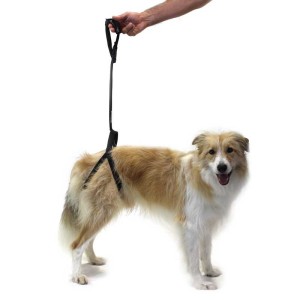 It is important to get the dog to work with the hind legs, this can be achieved by walking on the short leash and indicating to the dog that he must carry weight in the posterior ones, it will be practically impossible if the dog has pain in the hips, knees or some other structure of the posterior third.
Squats (making the dog sit down and get up a few repetitions in a row) will be another of the exercises that we will use; We must reserve this exercise for when the dog does not have pain in the hindquarters and its muscle mass is enough to withstand this exercise or failing that we can help ourselves with a harness for posteriors to help the dog get up.
Working in the water with the underwater treadmill is one of the best exercises since they strengthen the muscles protecting the joints. The sloping walks is another of the exercises that we must practice, the inclination of the slope will force more the posterior third and the dog will work more and increase the muscular power of the posterior third. This can be done both on a climb and on a rolling tapestry with inclination.
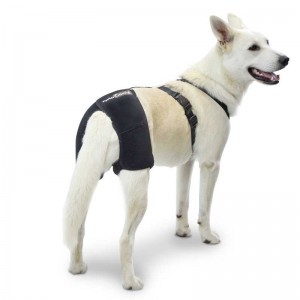
In the later phases of treatment weights can be used for muscle strengthening in dogs.
There are several solutions that can help us to be able to perform these exercises better, so that the dog feels better and can perform these exercises correctly, thus increasing the strength in the posterior third such as knee pads, tarsal supports, hip support, or boots or foot protectors in case of problems in the plantar area.
Director of Ortocanis
